

Outcomes

Does CV inflammation increase the risk of mortality?
The evidence is mounting: Inflammation is not only associated with increased CV risk and worse CV outcomes, it’s also a key suspect in CV death.1,2
Connecting the clues
Elevated levels of inflammation in CVD are associated with increased risk of CV death in patients with ASCVD and prior MI:

2.5x increased risk of CV death
for patients with inflammation compared to those without, in individuals with or at high risk of ASCVD1*

44% increase in the risk of CV death
in patients with prior MI and inflammation2†
Footnotes
* A collaborative analysis of 31,245 statin-treated patients who had or were at high risk of atherosclerotic disease from across the PROMINENT (n = 9,988), REDUCE-IT (n = 8,179), and STRENGTH (n = 13,078) trials found that residual inflammatory risk was significantly associated with CV mortality (highest hsCRP quartile [> 4.2 to > 4.8 mg/L] versus lowest [< 1.1 to < 1.2 mg/L], adjusted HR 2.68, 95% CI [2.22, 3.23]; p < 0.0001).1
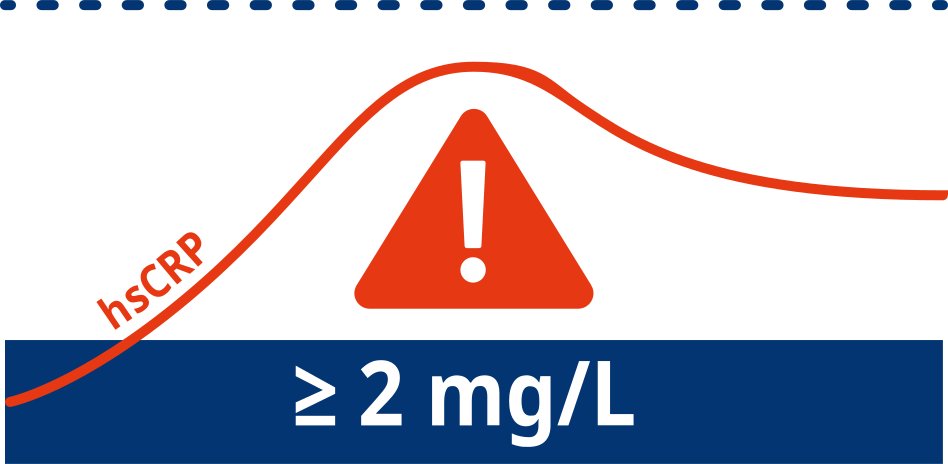
† Adjusted for age, sex, time since myocardial infarction, hemoglobin, eGFR, undertaken procedures, comorbidities and ongoing medications. Compared with hsCRP < 2 mg/L, patients with hsCRP ≥ 2 mg/L had a 1.44 (95% CI [1.29, 1.60]) higher risk of CV death.2
† Adjusted for age, sex, time since myocardial infarction, hemoglobin, eGFR, undertaken procedures, comorbidities and ongoing medications. Compared with hsCRP < 2 mg/L, patients with hsCRP ≥ 2 mg/L had a 1.44 (95% CI [1.29, 1.60]) higher risk of CV death.2
Inflammation leaves its fingerprints across many serious CV events
In patients with ASCVD
Inflammation can increase the risk of MACE, hospitalization for heart failure, and all-cause mortality:

 30% risk of MACE
in patients with inflammation (hsCRP ≥ 2 mg/L) versus those without6*
 24% risk of hospitalization for heart failure
in patients with inflammation (hsCRP ≥ 2 mg/L) versus those without6†
 35% risk of all-cause mortality
in patients with inflammation (hsCRP ≥ 2 mg/L) versus those without6‡
In patients with prior MI
Inflammation can increase the risk of MACE and all-cause mortality:
28% risk of MACEin patients with inflammation (hsCRP ≥ 2 mg/L) versus those without2¶
42% risk of all-cause mortalityin patients with inflammation (hsCRP ≥ 2 mg/L) versus those without2§
Footnotes
* The adjusted relative rate of events in participants with hsCRP ≥ 2 mg/L (vs. hsCRP < 2 mg/L) was 30% higher for MACE (adjusted HR 1.30; 95% CI [1.27, 1.33]). Adjusted for age, sex, time since ASCVD, eGFR, albuminuria, comorbidities, undertaken procedures, and ongoing medications.6
† The adjusted relative rate of events in participants with hsCRP ≥ 2 mg/L (vs. hsCRP < 2 mg/L) was 24% higher for heart failure (HR 1.24; 95% CI [1.20, 1.30]). Adjusted for age, sex, time since ASCVD, eGFR, albuminuria, comorbidities, undertaken procedures, and ongoing medications.6
‡ The adjusted relative rate of events in participants with hsCRP ≥ 2 mg/L (vs. hsCRP < 2 mg/L) was 35% higher for all-cause mortality (HR 1.35; 95% CI [1.31, 1.39]). Adjusted for age, sex, time since ASCVD, eGFR, albuminuria, comorbidities, undertaken procedures, and ongoing medications.6
¶ Adjusted for age, sex, time since myocardial infarction, hemoglobin, eGFR, comorbidities, undertaken procedures, and ongoing medications. Compared with hsCRP < 2 mg/L, patients with hsCRP ≥ 2 mg/L had a 1.28 (95% CI [1.18, 1.38]) higher risk of MACEs.2
§ Adjusted for age, sex, time since myocardial infarction, hemoglobin, eGFR, comorbidities, undertaken procedures, and ongoing medications. Compared with hsCRP < 2 mg/L, patients with hsCRP ≥ 2 mg/L had a 1.42 (95% CI [1.31, 1.53]) higher risk of MACEs.2
† The adjusted relative rate of events in participants with hsCRP ≥ 2 mg/L (vs. hsCRP < 2 mg/L) was 24% higher for heart failure (HR 1.24; 95% CI [1.20, 1.30]). Adjusted for age, sex, time since ASCVD, eGFR, albuminuria, comorbidities, undertaken procedures, and ongoing medications.6
‡ The adjusted relative rate of events in participants with hsCRP ≥ 2 mg/L (vs. hsCRP < 2 mg/L) was 35% higher for all-cause mortality (HR 1.35; 95% CI [1.31, 1.39]). Adjusted for age, sex, time since ASCVD, eGFR, albuminuria, comorbidities, undertaken procedures, and ongoing medications.6
¶ Adjusted for age, sex, time since myocardial infarction, hemoglobin, eGFR, comorbidities, undertaken procedures, and ongoing medications. Compared with hsCRP < 2 mg/L, patients with hsCRP ≥ 2 mg/L had a 1.28 (95% CI [1.18, 1.38]) higher risk of MACEs.2
§ Adjusted for age, sex, time since myocardial infarction, hemoglobin, eGFR, comorbidities, undertaken procedures, and ongoing medications. Compared with hsCRP < 2 mg/L, patients with hsCRP ≥ 2 mg/L had a 1.42 (95% CI [1.31, 1.53]) higher risk of MACEs.2